

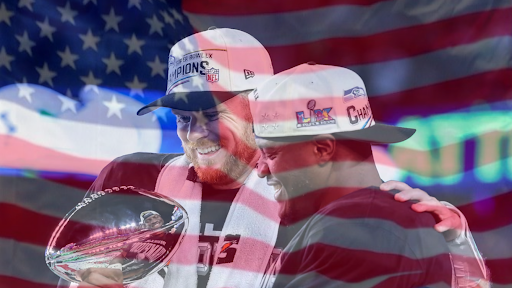
Every February, millions of families in the U.S. and worldwide gather for the only event where bad calls, bad karaoke, and Bad Bunny come together into one: the Super Bowl. On Feb. 8, the Seattle Seahawks and the New England Patriots played in Super Bowl 60. The Seahawks beat the Patriots 29-13, a revenge game for Super Bowl 49, only ten years ago where the Patriots narrowly beat the Seahawks 28-24. This year also marks the third time the Super Bowl has been held in San Francisco, making it the fifth most frequent host city in the NFL. Finally, Super Bowl 60 reached a peak of 125 million viewers, making it second only behind last year’s, but that begs the question: why?
Unsurprisingly, a large percentage of those viewers are simply sports fans. However, the fact that many watchers don’t follow football at all displays how the Super Bowl has become more than a game; it’s now a cultural phenomenon where the best of America’s music, commercials, and football players come together in an event more watched than the moon landing.
In fact, this year’s halftime show is a unique testament to this reality. The theme of the show was of a unified America, composed of all North, South, and Central American nations standing together. This message exemplifies the cultural convergence that is the Super Bowl, but even more than that, the numbers show how it’s more than football: 135 million people watched the halftime show, over 10 million more than the height of the game.
However, it’s one thing to draw people in and another to keep them there. The Super Bowl’s evolution has come with a number of factors that essentially guarantee its spot on millions of TVs. Most significantly, football as a sport is designed to form emotional bonds: even for viewers who don’t follow either team, the constant presence of an underdog allows people to connect and sympathize with one team or the other, ensuring emotional commitment. Beyond that, the notoriety of Super Bowl commercials gives viewers a reason to stick around as to not miss anything.
Overall, it’s easy to see why the Super Bowl has become so popular: it’s the only program where one can observe a long field goal, a Puerto Rican wedding, and a song about bananas in one sitting. As such, the event is a perfect representation of American culture as a whole in that it brings millions of different people together for a common purpose. Next year’s Bowl will be in Los Angeles, and one can only imagine what will come next February; the only certainty is that they will be watching.