
This year’s 2026 Milan Cortina games proved the Olympics are about more than medals. Throughout the 21st century, social media has demonstrated an increasing change in how audiences perceive the Olympics. These games highlighted the dangers social media has towards the growing Olympic pressure and the judgement of athletes.
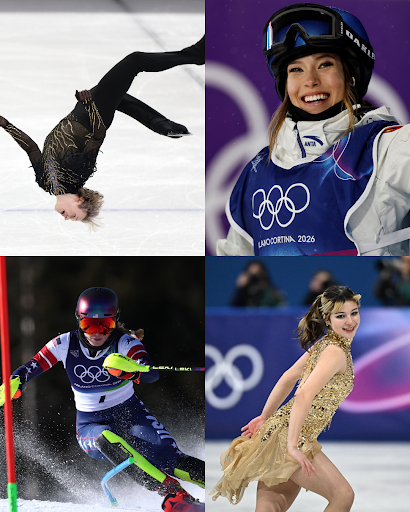
One of the most talked about athletes in the U.S. figure skating team was Ilia Malinin. Despite Milan being his first Olympics, Malinin was already well known in figure skating as the first skater to land the quadruple axel; a jump previously considered impossible. Therefore, heading into the games, Malinin was considered a gold medal favorite. In the team event, his strong performances led Team USA to reach the top of the podium. However, when competing for the individual medal, Malinin finished eighth after a disappointing free skate.
Afterwards, Malinin posted to Instagram providing an insight into his mental health.
“On the world’s biggest stage, those who appear the strongest may still be fighting invisible battles on the inside. Even your happiest memories can be tainted by the noise,” Malinin’s statement read.
Now Malinin was not the only athlete on Team USA with this sentiment. Alpine skier Mikaela Shiffrin is frequently considered one of the best women’s slalom skiers. Nonetheless, in one of her races she experienced a shockingly slow slalom run. Like Malinin, she similarly acknowledged the pressure she faced.
“The Olympics asks us to take a real risk on the world stage,” Shiffrin wrote. “One that requires courage and vulnerability to erroneous judgment and narratives built on a limited understanding of what this sport truly demands.”
Despite the disappointing performances from Malinin and Shiffrin, these moments did not take away from their overall Olympic performances. After all, both athletes won gold in other events. Now, their one off mess ups do demonstrate the mental stressors placed on athletes when social media and traditional media place them on a god-like pedestal. Ultimately, this is something likely to never change, but it is something audiences and the media are becoming increasingly aware of.
Outside of Olympic performance pressure, viewers also used social media as a platform to compare and judge athletes.
For example, throughout socials and traditional media in China and the US, many continue to compare freestyle skier Eileen Gu and figure skater Alysa Liu. The basis of this comparison stems from their similar backgrounds. Both were raised by single Chinese immigrants and grew up in the Bay Area. However, Liu represents Team USA while Gu represents Team China.
US media paints Gu as somewhat of a villain. Political commentator Tucker Carlson wrote an article labeling Gu as the Winter Olympics true villain. One popular post on X encouraged people to be an Alysa Liu “in a world of Eileen Gus.” Comments on social media have even gone as far to call Gu a traitor, despite not being one of the first Americans to represent a different country.
Meanwhile in China, praise for Liu is often censored due to the fact that her dad was a part of the famous Tiananmen Square protest.
“Eileen Gu is a hero of China while Alysa Liu is a descendant of an anti-China figure,” a Chinese social media post read.
The language around these athletes is quite similar as both the US and China see the other athlete as a traitor. It is also important to note that Gu and Liu do not see each other as opposers, like social media tries to make them out to be. In fact, Liu even recently called out critics of Gu, labeling them as hypocrites.
Overall, in the context of the Olympics, social media remains a double edged sword. On one hand, Olympic pressure and scrutiny is intensified through the easy access of social media. On the other hand, social media provides immense value to athletes in allowing them to build a brand and community.